
How to Maximize Stone Slab Yield: Stop Losing Margin on Custom Countertops
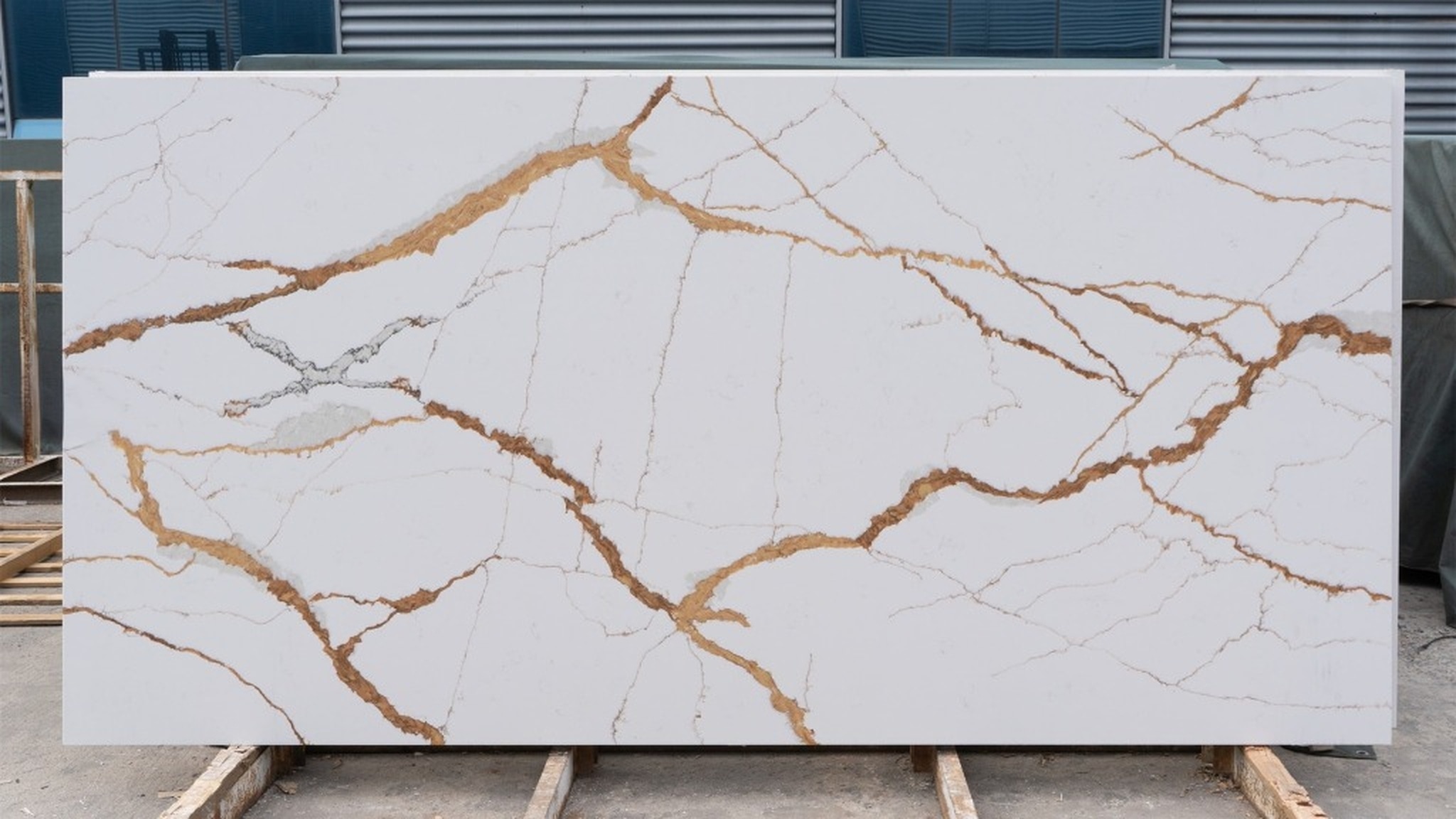
Figure 1: High-grade Calacatta slab material staged on support racks. Protecting slab yields on premium quartz and exotic granites directly determines a countertop shop's net profit margin.
To maximize stone slab yield, countertop fabricators must transition from manual layout guessing to automated computational nesting. By utilizing specialized fabrication software to nest layouts before making a single cut, shops can increase their material yield by up to 20%, automatically track usable remnants, and prevent hidden profit loss on complex countertop layouts.
If you are running a modern fabrication shop, you already know the hardest truth of the trade: your profit margin isn't decided by how much you sell a job for; it is decided by how efficiently you cut the slab.
A single mistake in layout planning, or a failure to account for massive sink cutouts and vein matching, can force you to buy an entirely new slab for a job that was quoted for one. Instantly, your profit vanishes.
Here is how top-performing shops are modernizing their workflow to eliminate waste, speed up production, and protect their margins.
The Trap of "Square-Foot" Quoting
The biggest mistake fabricators make happens before the material even hits the shop floor. It happens in the showroom.
Many estimators still quote custom jobs based purely on the raw square footage (or square meters) of the countertops. On paper, an L-shaped countertop layout with an island might look highly profitable. But raw area calculations ignore the physical reality of the stone.
When you factor in the grain direction, required margins for the bridge saw blade, and awkward sink placements, a job that mathematically equals "1.5 slabs" might actually require cutting into a third slab just to extract a single return piece. If you quoted the customer by the square foot, you swallow the cost of that third slab.
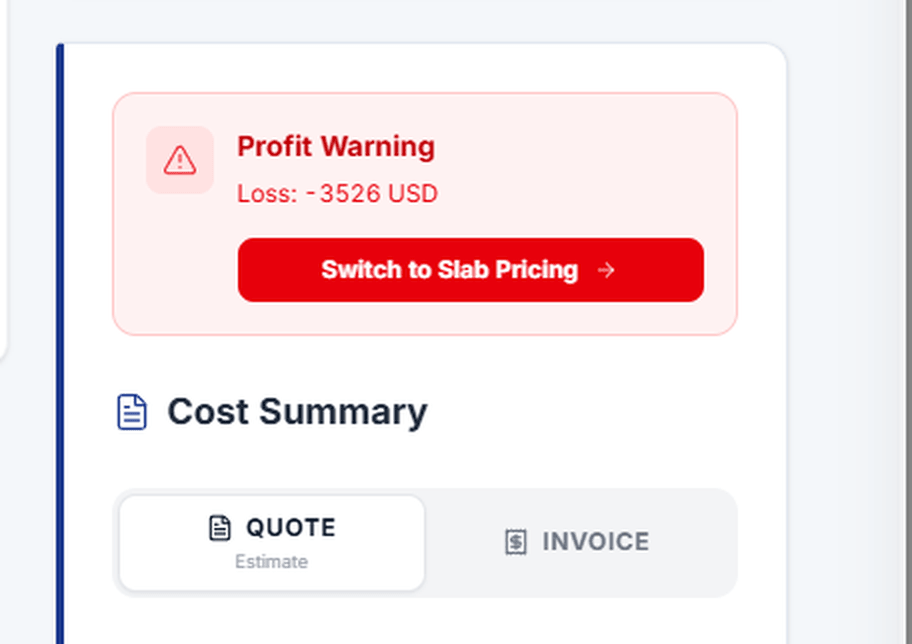
Figure 2: StoneHub's automated Profit Warning alert instantly flags quotes where complex cutout shapes or seams require shifting the client contract to a full-slab billing model.
The Fix: Your estimating workflow must be tied directly to your slab pricing. Modern quoting tools alert your sales team the moment a layout crosses the threshold where area-pricing becomes a net loss, warning them to shift the contract to a full-slab billing model before the quote is ever sent.
Automating Your Slab Nesting for Maximum Yield
Relying on a saw operator to mentally calculate the most efficient layout while standing in a dusty shop is a recipe for high waste percentages.
To squeeze every usable inch out of expensive inventory, fabrication shops are moving to algorithmic nesting.
Instead of manual guesswork, software engines can instantly analyze a DXF layout and calculate the absolute most efficient way to arrange the rectangles, islands, and backsplashes on the digital slab.
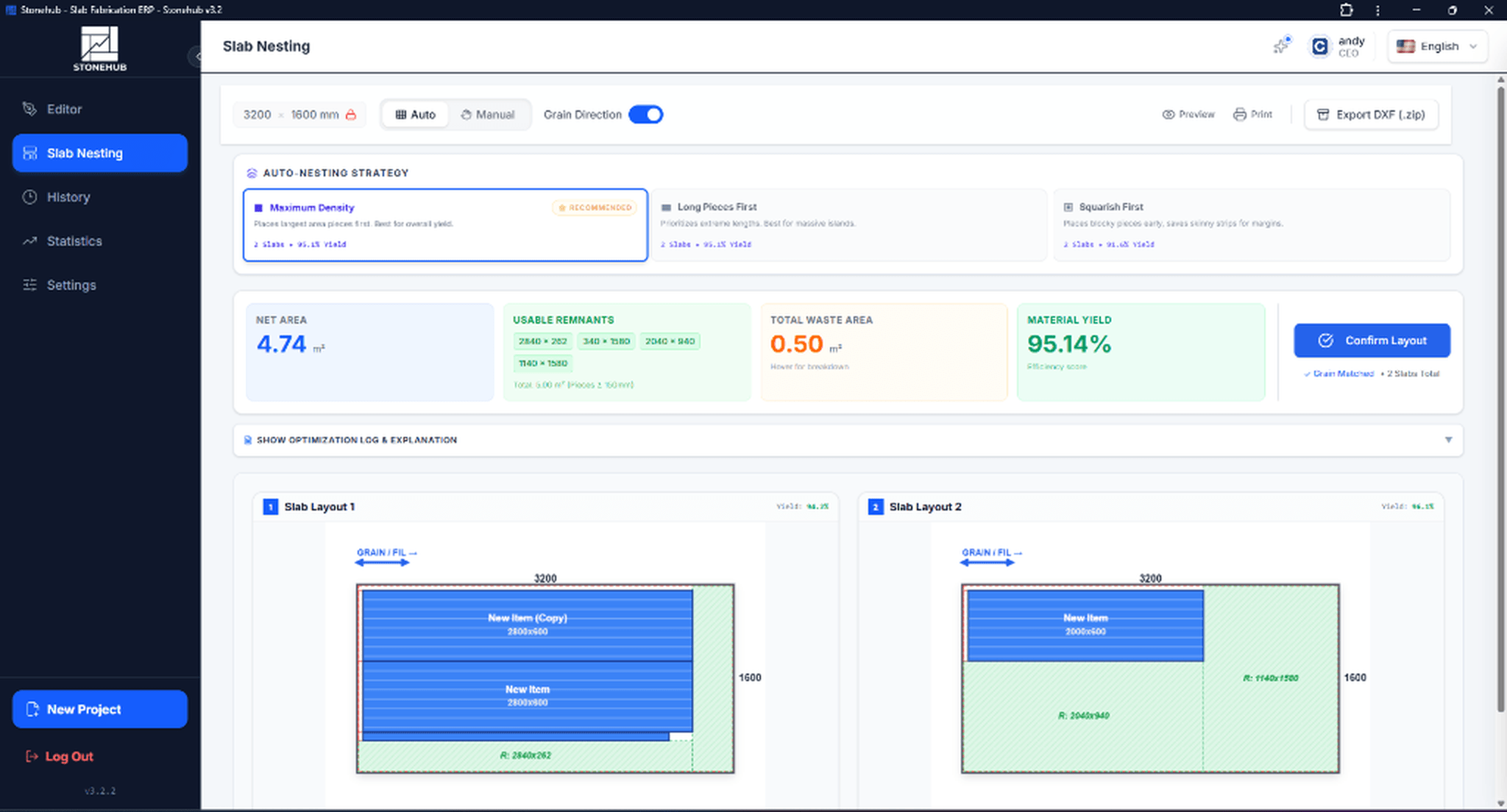
Figure 3: StoneHub's maximum-density nesting engine automatically packs layout patterns onto slabs, ensuring a target yield of 95% or higher on standard jobs.
By applying strategies like "Maximum Density," the software prioritizes placing the largest pieces first and tucking smaller splashbacks into the remaining margins. If the stone has a heavy, directional vein, operators can toggle "Manual Mode" to quickly rotate pieces to ensure the grain flows perfectly across the customer's island piece.
Bridging the Office to the CNC Machine
A highly optimized layout is useless if it creates a bottleneck on the shop floor.
Historically, the front office would draw a layout, print it on paper, and hand it to the production manager. The CNC operator would then have to waste 30 minutes manually reprogramming those exact dimensions into the bridge saw.
Today, that workflow is obsolete.
Once an optimized nest is approved in the software, it should generate a standard .zip DXF file. With one click, that file is exported directly to the shop floor machinery. The bridge saw knows exactly where to cut, eliminating manual data entry, preventing transcription errors, and keeping the machinery running non-stop.
Stop Losing Money in the Remnant Graveyard
Every fabricator has a remnant graveyard—a corner of the shop filled with unmarked offcuts that eventually get thrown in the dumpster because nobody knows their exact dimensions.
When you use smart nesting software, remnant tracking becomes automatic. When a slab is cut, the software identifies any remaining pieces that exceed your minimum usable size, tags them with their exact dimensions (e.g., 2840 x 262mm), and logs them into your inventory.

Figure 4: Automated remnant logging records piece sizes directly into inventory data, keeping stock updated in real time.
The next time a customer walks in asking for a small bathroom vanity, you don't have to cut into a fresh slab. You simply pull the exact remnant from your digital inventory, turning pure waste into pure profit.
Protect Your Margins with StoneHub
You cannot control the rising cost of raw granite and quartz, but you can absolutely control how much of it ends up in the dumpster.
By upgrading your shop's software, you can align your sales estimators with your CNC operators, ensuring every quote is profitable and every cut is optimized.
Stop guessing your yield.
Ready to Stop Bleeding Margin?
Start your 14-day free trial of StoneHub today and see exactly how much material our auto-nesting engine can save your shop this week.
Setup in 60 seconds. No credit card required.